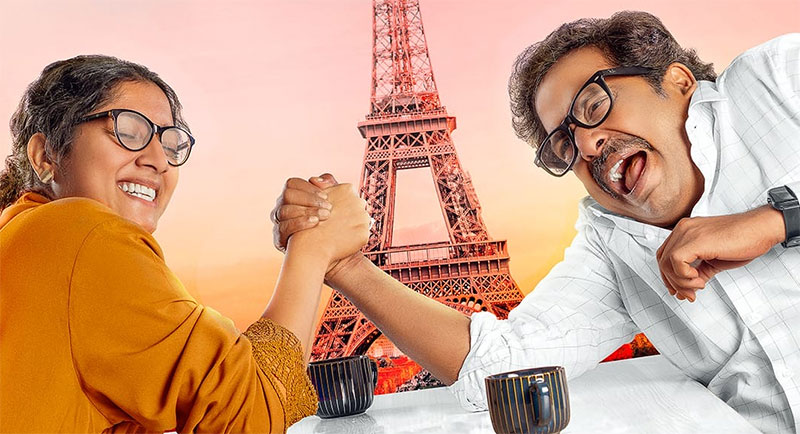
Government doctor Guru Somasundaram and architect and social worker Anumol are a married couple who fell in love and got married. They live such a happy and ideal life together that they appear to be the perfect couple.
Meanwhile, Guru Somasundaram travels to Paris, the capital of France, to attend a medical conference. There, he is shocked when he sees a photograph of a happy young couple from Chennai displayed at a café. When he enquires about the photograph, he learns about the couple and becomes deeply disturbed. He returns to Chennai with the same anxiety and tells his wife the truth about the young couple, including the fact that they are no longer alive.
After hearing what Guru Somasundaram tells her, Anumol learns more about the young couple through newspaper reports. She becomes angry with Guru Somasundaram and leaves him. Their daughter Archana learns about her parents’ separation and returns from the United States with her boyfriend Vijay Vishwa. She attempts to bring her parents back together.
Did her efforts succeed? Who were the young lovers? What connection did their deaths have with Guru Somasundaram? ‘Paris Cafe’ answers these questions while addressing the issue with social concern.
Recognizing that cinema is not merely a medium of entertainment but also a powerful medium for bringing social issues to the attention of the public, director Saraj Seelan has joined the list of filmmakers who have addressed a social issue in their very first film.
Guru Somasundaram and Anumol, who play the central husband-and-wife characters, strengthen the screenplay through their natural performances.
Anumol discovers that her husband was also involved in covering up an honour killing and becomes furious. She emotionally portrays her character as the voice and anger of the families affected by such incidents.
Guru Somasundaram’s character commits an act for the sake of his family, despite knowing that it is wrong, and is also prepared to face the consequences for the sake of the same family. His restrained performance works well, while his occasional humorous dialogue delivery brings laughter to the audience.
Vijay Vishwa and Archana, who play the young lovers, bring freshness to the scenes through their energetic performances. Another couple, Sai Vicky and Nayana Sai, deliver performances that leave an emotional impact on the audience.
Cinematographer Satheesh G. has effectively integrated foreign locations such as the United States and Paris into the film using graphics, while filming the sequences in a manner suited to the producer’s budget.
The songs composed by K are pleasant to listen to. The background score also supports the film effectively.
Although the film deals with honour killings and their background, editor V.J. Sabu Joseph’s work greatly supports the director’s attempt to present the subject in a different style.
Director Saraj Seelan raises his voice against honour killings, but rather than presenting the subject as propaganda or a lecture, he tells it as a beautiful love story through a young couple and a married couple who face life’s joys and hardships together. He combines this with an engaging and fast-paced screenplay.