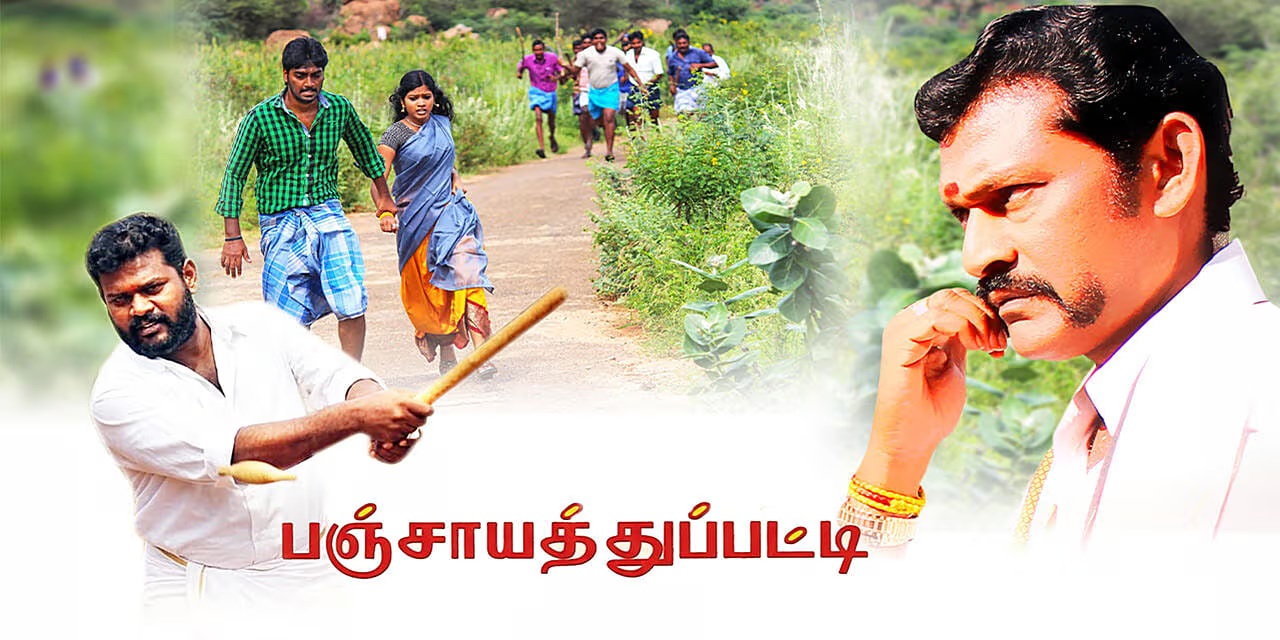
The story unfolds through a group of college students who visit a village to document its history. What began as a small settlement on the banks of a river gradually developed into a village inhabited by numerous families. The descendants of the family that first settled there have traditionally served as the village headmen for generations.
Twin boys born into this family are named Amavasai and Pournami. As they grow older, they divide the village’s authority between themselves. One serves as the headman from Amavasai to Pournami, while the other takes charge during the remaining days. The village’s panchayat functions according to this unusual arrangement.
Meanwhile, two young lovers from the village face opposition to their relationship. They leave their hometown, get married, and eventually return. However, the village headmen ostracise them and refuse to allow them to live as part of the community.
A young man who stands up for his friend questions the injustice of this decision and challenges the headmen’s authority. In response, they impose an unusual condition: the couple’s family will be allowed back into the village only if he defeats one of the headmen in a traditional game called Kottipul.
Having never played the game before, the protagonist begins learning its techniques and prepares to take on the challenge. Does he succeed? Can he put an end to the headmen’s authority? Will the ostracised family be allowed to return to the village? The rest of the film answers these questions.
Performances
Jai, who plays Vishnu, delivers a performance suited to the role of a simple village youth. He brings out the character’s qualities in scenes where he stands up for his friend and confronts the village headmen.
Vinosehree, who plays the female lead Kayalvizhi, portrays the natural mannerisms of a village girl.
The two village headmen are among the film’s biggest strengths. Prabhakaran, who plays Amavasai, makes a strong impression through his authoritative demeanour and antagonistic behaviour. Kesavan, who plays Pournami, also handles his role effectively and provides a fitting counterpart to Amavasai. The panchayat scenes built around these two characters give the film a distinctive identity.
The comedy sequences featuring Spanner Pandi and Nattu Bolt lighten the seriousness of the story and provide moments of amusement. Kannan, who plays the character known as America, also contributes to the humour. Rangan, in particular, delivers comedy through his facial expressions and body language in his role as a mute character.
Technical Aspects
Natural visuals are an important element of films centred on rural life. In this regard, Mohandas’s cinematography captures the village atmosphere and the everyday lives of its residents. He has also handled the film’s editing.
The music by Divakar and Rajiv complements the emotions of the rural narrative. The songs fit the situations in which they appear. The lyrics by Rajiv and Mohandas, along with Rajun’s art direction, contribute to the film’s overall atmosphere.
Direction and Screenplay
Although the central idea of Panchayathu Patti is simple, director Mohandas has chosen an unusual setting in which to tell the story.
Village-headman dramas typically revolve around power struggles, family feuds, or property disputes. In contrast, this film attempts to resolve a conflict arising from a love marriage and the village’s restrictive customs through a game of Kottipul. This unusual premise is one of the film’s more interesting aspects.
The film can also be seen as an attempt to remind today’s younger generation of a traditional game that was once popular in rural communities. Kottipul is not merely a game here; it becomes a weapon that the protagonist uses to fight for his friend’s rights.
The director’s approach is evident in the way he uses comedy to address issues such as the headmen’s authority, restrictive village customs, and the punishment imposed on the lovers. The story also conveys the idea that decisions made by those in positions of power are not necessarily fair or just.
Rather than relying on grand spectacle or high-octane fight sequences, the director attempts to create an entertaining film using rural characters, their conflicts, and humorous incidents.
Although some developments in the story are predictable, the unusual division of authority between the two headmen and the events surrounding the Kottipul competition provide a reasonable degree of interest. The film could have been more engaging with a brisker screenplay and greater freshness in its comedy sequences.
Nevertheless, the director deserves appreciation for his attempt to tell a simple story with humour against a rural backdrop.