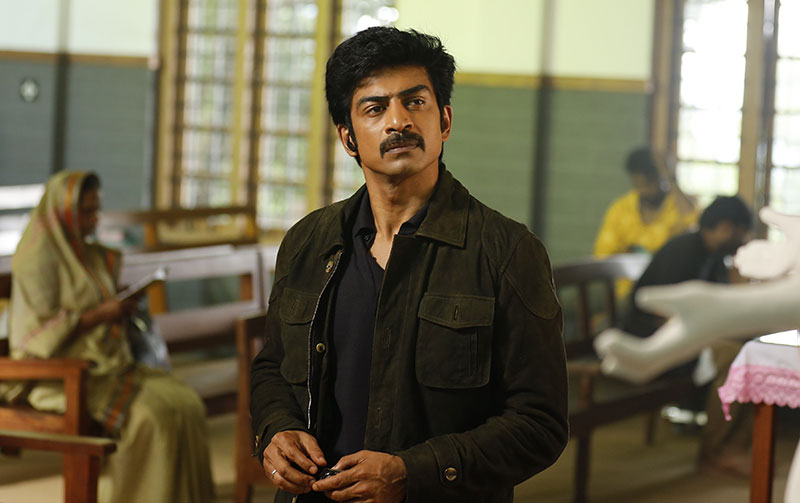
A car meets with an accident and falls into a lake in Kerala. The body of a young boy is found inside the vehicle. The police initially close the case as an accident. However, Kerala police officer Arjun Das, who carefully examines the submerged car, the available evidence and the post-mortem report, launches a detailed investigation and discovers that the boy was deliberately murdered.
Meanwhile, a young boy goes missing in Tamil Nadu. Suspecting a connection between the missing boy and the murder in Kerala, Arjun Das travels to Tamil Nadu and begins gathering information about the missing child. His investigation confirms similarities between the two incidents. However, Sanjana Natarajan, the Tamil Nadu police officer handling the missing boy’s case, refuses to cooperate with him and repeatedly dismisses his findings.
In a shocking turn of events, the missing boy is found by the roadside in a severely traumatised mental state. This further strengthens Arjun Das’s suspicions. He discovers that both incidents were connected to the same person and that the culprit is a psychopathic killer. Determined to catch the murderer before another child becomes a victim, Arjun Das begins an intense investigation. How he tracks down the killer and what drives these crimes form the central plot of *John Doe*. The film attempts to narrate this investigation through a different approach rather than following conventional thriller storytelling.
The title *John Doe* does not refer to a particular person’s name. It is a generic placeholder used to identify an unknown individual. Accordingly, the title reflects the investigation into the identity of an unidentified deceased boy, which eventually uncovers shocking truths about a psychopathic killer and several young victims.
Making his debut as a police officer, Arjun Das proves that he can bring the authority and commanding presence of a police uniform to the screen, beyond his distinctive voice. Rather than relying on physical violence to extract information from suspects, his character uses psychological tactics to uncover the truth. Through his investigative approach and commanding screen presence, Arjun Das delivers a refreshing portrayal of a police officer. However, a few of his dialogues are difficult to understand.
Sanjana Natarajan, who plays a Tamil Nadu police officer, does complete justice to her character with her energetic performance. She beautifully portrays the softer, romantic side of a police officer through a few brief scenes. She delivers a convincing performance and wins the audience’s appreciation.
Zara Vineeth Santhosh, who plays Lucky, young Nirav S. in the role of Hridai, Srishti Y. as the children’s mother, VJ Archana as Arjun Das’s younger mother, Badava Gopi as his father, and Karthik Kumar as Dr. Ranjan are all well-cast. Every actor fits their respective roles convincingly.
Cinematographer Preetha Jayaraman transforms the naturally beautiful landscapes into an atmosphere filled with suspense and tension, creating an unsettling experience for the audience. Although the film revolves around a psychopathic killer, it avoids excessive on-screen violence and effectively conveys the emotional and psychological impact of the crimes.
Mujeeb Majeed’s music, along with the additional score by The Artist 404, avoids conventional thriller-style background music. Instead, the restrained compositions create tension through silence itself. In particular, the song “Naan Podhuma…” is memorable and deserves repeated listening. It also complements the narrative effectively.
Editor Vijay Venkataramanan has handled the psychological crime thriller in a simple and accessible manner. However, the twists in the screenplay pass by rather easily, and the protagonist manages to identify the culprit without much difficulty. This makes the overall narrative feel somewhat lacking in intensity.
Writers Madhumitha and Nicolas Chevalier have taken a conscious approach to presenting a story about a psychopathic killer in a manner accessible to audiences across different age groups. At the same time, they strongly highlight the psychological consequences faced by children who undergo traumatic experiences.
Director Madhumitha, who has explored different genres in her previous works, deserves appreciation for creating suspense through the characters’ psychological journeys and intelligent investigative developments rather than relying on graphic violence.
Although the film offers a fresh perspective by exploring the psychological reasons behind the criminal’s mindset without portraying it in an unnecessarily disturbing manner, the screenplay loses some of its strength because the protagonist gets closer to the culprit too easily, before the audience can fully develop curiosity about what happens next.
Nevertheless, the director deserves appreciation for breaking the common perception that psychological thrillers must contain disturbing violence and for presenting a relatively family-friendly thriller.