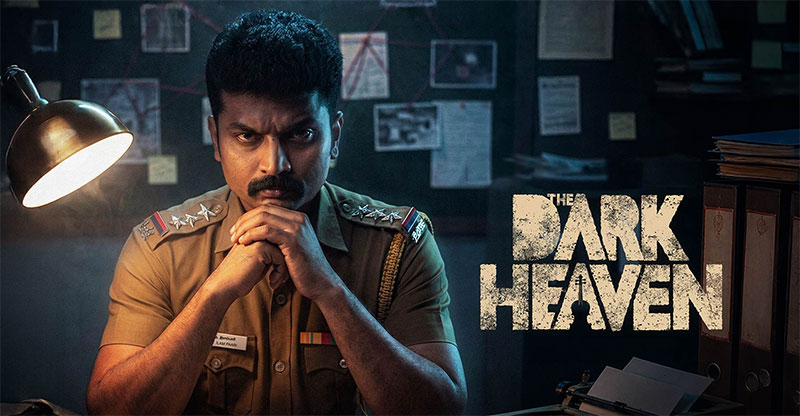
In a mountainous village located on the Tamil Nadu–Kerala border, men mysteriously die once every seven years, during the seventh month of the year. The villagers believe that these deaths are caused by the curse of a forest deity and regularly perform various rituals to appease the deity. On the first day of the seventh month—the time of year that the villagers fear the most—Siddhu, the newly appointed police inspector of the village, arrives with his wife Darshika and their infant child. However, he refuses to believe the stories told by the villagers.
Meanwhile, a young woman goes missing in the village. While investigating the case, Siddhu discovers that she had gone in search of a young man. When he starts looking for that man, he learns that he too has disappeared. Shortly afterwards, the missing woman’s friend also goes missing. Eventually, all three are found brutally murdered at the same location.
With no clues to work with, Siddhu continues investigating the three murder cases. During this period, his wife and another man are also murdered. The police close the case by claiming that a psychopathic killer who escaped from a prison in Kerala was responsible for all five murders. Siddhu, however, refuses to accept this explanation and begins investigating the mystery behind the killings. How does he uncover the truth? Who is the killer? Why were these murders committed? ‘The Dark Heaven’ answers these questions through unpredictable twists and a highly thrilling narrative.
The film has three interconnected storylines—a book titled ‘The Dark Heaven’ that predicts what is going to happen, the mystery surrounding the village, and the series of murders. Although all three stories are connected, director Balaji goes beyond those connections and presents the murders and their investigation as a gripping crime thriller that keeps viewers on the edge of their seats.
Siddhu, who makes his debut as a lead actor on the big screen after coming from television, delivers an impressive performance in a demanding role that requires him to express a wide range of emotions. He convincingly portrays a police officer who speaks very little and keeps his emotions under control throughout the investigation.
Darshika, who plays Siddhu’s wife, Rithvika, who portrays a woman from the mountain village, and Pradeep, who plays a police constable, along with Vela Ramamoorthy, Nizhalgal Ravi, Jayakumar, Arul T. Shankar, Sathya, Chaplin Balu and the rest of the cast, are all well-suited to their respective roles. Since the screenplay gives even the smaller characters enough importance to attract the audience’s attention, all the actors leave a lasting impression.
Cinematographer Manikandan P.K. has filmed most of the movie in a single location. However, by presenting the location from different angles, he creates an atmosphere of constant tension and keeps the audience uneasy.
Composer Sakthi Balaji has worked in tandem with the cinematographer. His background score heightens the tension throughout the film, while the violin-based score creates an eerie atmosphere that frightens the audience.
Despite having three different storylines, editor Raja Arumugam keeps the director’s screenplay moving smoothly—from the beginning and progression of the story to its conclusion. He has edited the sequences in a way that keeps the audience’s expectations alive until the final scene.
Writer-director Balaji takes the familiar premise of investigating a series of murders and their hidden background and takes it in a fresh direction, successfully holding the audience’s attention throughout the film.
Even if viewers try to guess why so many murders have taken place and who the killer is, director Balaji introduces twists that invalidate their predictions. The way he maintains the suspense through the screenplay until the final scene deserves appreciation.
Director Balaji brings together several elements—a mysterious book, a village where mysterious incidents occur, a psychopathic killer and a series of murders. Rather than confusing the audience with these multiple elements, he handles each of them effectively within the screenplay and keeps the film interesting and fast-paced.