Set during British India, the film portrays the Savari community living under the oppressive rule of the Indian elite. After independence, they yearn to live freely and establish an identity of their own. However, the dominant class, driven by an oppressive mindset, continues to suppress them and keep them subjugated. The community continues its struggle for recognition and identity.
Nani, born into the Savari community, follows in his mother’s footsteps and fights against oppression. He attempts to free his people from slavery and help them establish their own identity. Whether he succeeds or not forms the core of The Paradise, told against a backdrop of a sea of blood and piles of corpses.
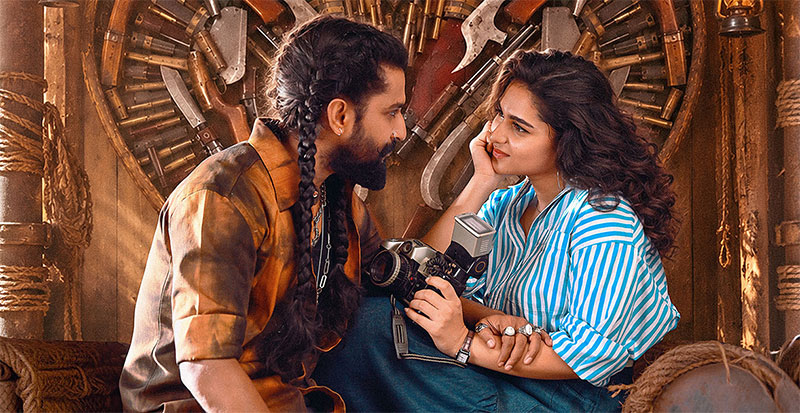
Nani, who appears with twin braids as the character Jadal, carries the film on his shoulders with his intense performance. However, the excessive violence prevents his performance from making the desired impact.
Kayadu Lohar, who plays the female lead, has been used largely as a glamour element, but she makes an impression through the way her character has been written as an equal to the male protagonist. Since her scenes provide some relief to the audience, one cannot help but feel that she could have been given more screen time.
Mohan Babu, who plays the antagonist, carries himself with great authority, living up to the saying, “A lion remains a lion even in old age.” Although he appears in two different looks representing youth and old age, he delivers a commanding performance in both and brings plenty of mass appeal.
Sonali Kulkarni, who plays Nani’s mother, along with Sampurnesh Babu as his friend, Tanikella Bharani, Vishika, Krishna Teja, Eswari Rao and the other supporting actors have all performed their roles effectively.
Cinematographer C.H. Sai realistically captures the filthy, slush-filled surroundings and the Savari people living there. Although the film is filled with artificiality, he presents the world on a grand scale.
The songs and background score by Anirudh add strength to the violent sequences as well as the emotional struggles of the characters.
Editor Naveen Nooli’s work becomes tiring for the audience because of the film’s excessive runtime, largely caused by the numerous action sequences.
Writer-director Srikanth Odela takes the one-line idea of a protagonist fighting to break the chains of slavery and builds the entire screenplay around it. The hero fights, then gets beaten, and this pattern continues almost throughout the film. As a result, the screenplay becomes repetitive and eventually tiresome.
The excessive violence, combined with the heightened imagination used in staging the sequences, becomes the film’s biggest weakness.
Nani’s performance, the way the filthy world of Paradise and the clothing of its oppressed inhabitants have been designed, and the creation of the Paradise world through sets and graphics are among the aspects worth appreciating. However, the lengthy runtime, relentless violence and the constant presence of bloodshed throughout the film can leave viewers feeling overwhelmed.