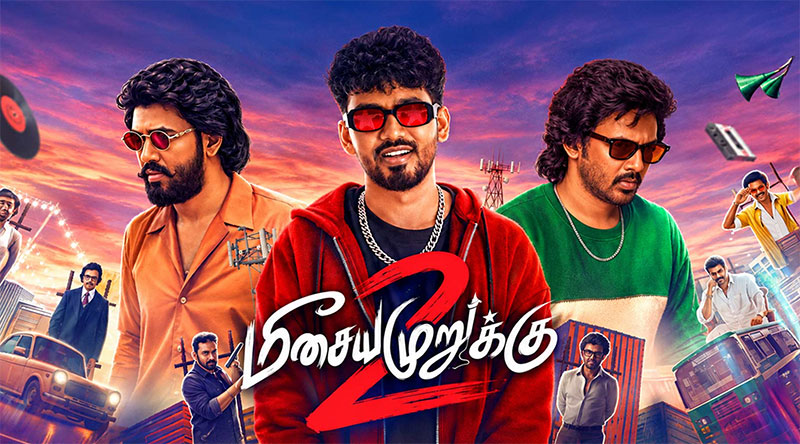
Gana singer Hip Hop Tamizha Aadhi attempts to take the art form beyond its limited circle and bring it to a wider audience. His efforts to perform Gana songs on various stages like other musicians fail, but his son takes up the same ambition and dreams of succeeding in the music industry. However, circumstances prevent him from achieving it. In the third generation, Hip Hop Tamizha Aadhi faces the same struggle. Whether he fails like his grandfather and father or succeeds in the music industry is narrated in a fun-filled manner aimed at entertaining youngsters in Meesaya Murukku 2.
Hip Hop Tamizha Aadhi, as usual, plays a character who gives advice to his younger brothers and sisters while also keeping them entertained and making them vibe with him. Moving throughout the film with a lively and celebratory attitude through songs and dance, Aadhi occasionally delivers philosophical messages and also attempts to spark a movement to gain recognition for Chennai Gana, particularly seeking to win the hearts of people from North Chennai.
Chaithra Achar, Kettika Sharma and Ramya Ranganathan, with one heroine representing each period in the story, have all performed their roles effectively.
Harshat Khan, who plays Aadhi’s friend, along with Karunas, Nassar, Aadukalam Naren, Sara and Karunakaran, have all made their contributions appropriately.
Cinematographer Balaji Subramaniam presents the entire film in a colourful manner and has handled the differences between the three time periods with finesse.
Editor Fenny Oliver has edited the sequences according to the director’s vision while ensuring that the film moves without losing its pace.
Hip Hop Tamizha Aadhi, who has written, directed and composed the music, uses the same central theme as the first part while adding a new element—the movement for recognition of Chennai Gana artists. He attempts to build the screenplay around this idea and appeal to the younger generation.
Understanding the pulse of youngsters, Aadhi has designed the songs and sequences in a way that turns the theatre into a grand celebration. Although the film contains numerous songs and is presented almost like a massive musical concert, it is disappointing that most of the songs, except for two, are difficult to understand. In particular, the climax song, which Aadhi heavily built up, is not clear at all.
The film follows Aadhi’s logic that a movie should be fun and entertaining. However, the fact that the screenplay travels along a similar path to the first part is somewhat disappointing. At the same time, Aadhi manages to overcome these shortcomings by filling the film with plenty of entertaining elements that allow his “younger brothers and sisters” to enjoy themselves. Once again, he succeeds in entertaining them and walks away with his signature moustache-twirling confidence.