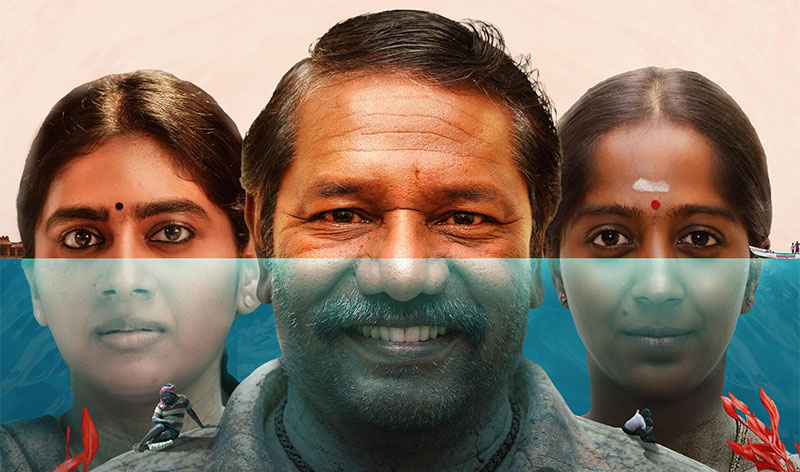
While performing the traditional rituals for their ancestors at the Theertham in Rameswaram, Thavasimuthu (Karunas) earns his livelihood by diving into the sea and collecting the coins that people throw into the water. During one such occasion, he finds a medal in the sea. When he decides to hand it over to the police, it lands him in serious trouble.
Some police officers try to seize the medal. When they fail, they attempt to frame Karunas in a temple jewellery theft case in order to save themselves. However, when it becomes clear that the medal is not related to the temple jewellery, they implicate him in another theft case.
Lawyer Nimisha Sajayan takes up the legal battle to rescue Karunas, who is in prison. Through her powerful arguments, she proves that Karunas is innocent. She then raises an unprecedented question in court on behalf of the common man who was punished despite committing no crime. The question shocks the judge, while Nimisha also seeks compensation for the victim that goes beyond monetary loss.
Although the compensation sought by Nimisha is against the government and appears impossible for the government to provide, the question creates a major uproar across the country. People begin raising various questions with the government. What is the question raised by the ordinary man Karunas? What is the compensation sought by lawyer Nimisha for the victim? ‘Enna Vilai’ narrates the answers to these questions in a manner that shakes the government machinery.
Though it is not new for ordinary people to be falsely accused and punished through the legal system, while some manage to fight through the same system and prove their innocence, director Sajeev Palavoor argues that it is the government’s responsibility to clear the false stigma placed on an innocent victim. He presents this idea through a powerful screenplay and impactful sequences, attempting to create a new legal revolution.
Karunas, who plays the lead character Thavasimuthu, does justice to the role through his screen presence and body language. He effectively portrays how deeply a false accusation affects an ordinary man who works hard for his family. His restrained performance, particularly in the emotional scenes, moves the audience to tears.
Nimisha Sajayan, who plays the lawyer, has dubbed her own voice for the film. Her emotional dialogues and confident performance in the courtroom sequences add considerable interest to the legal proceedings.
Vijayalakshmi Veeramani, who plays Karunas’s wife, and Sasha, who plays his sister, strengthen the screenplay through their natural appearance and performances.
Swaminathan and Kavithalaya Krishnan, who play lawyers, along with judges portrayed by Nizhalgal Ravi, Poornima Bhagyaraj and T.S.R. Srinivasan, and police officers played by Mohan Ram, Darshan and others, may appear only in a few scenes, but their characters are important to the screenplay and leave an impression on the audience.
Cinematographer Alby Antony has filmed the sequences using natural lighting, ensuring that the realistic quality of the setting is preserved. The sequences explaining who the protagonist is and the dangers involved in his profession may seem like explanatory portions, but the way they have been handled, along with the courtroom visuals, becomes one of the film’s major strengths.
Composer Sam C.S. moves completely away from his usual style and adds considerable strength to the film with a background score in a new format.
Editor Sreejith Sarang has neatly brought together the different paths through which the problem surrounding the medal develops and the subsequent courtroom arguments. This keeps the film fast-paced and engaging.
Although the victim receives justice through the legal battle, director Sajeev Palavoor raises a question to the legal system about the false accusation placed on him and the consequences he faces because of it. This is a question that has rarely, if ever, been raised in cinema. Likewise, the compensation he demands on behalf of the victim is unusual and appears practically impossible to provide. Nevertheless, through these questions and the idea of compensation, the director makes not only the public but also government departments reflect on the issue.
However, Karunas’s house, with its palm-leaf walls, feels highly artificial, especially in the present-day context, when even fishing villages largely no longer have such hut houses.
Although legal battles and courtroom arguments occupy a major portion of the film, director Sajeev Palavoor has handled them engagingly within the screenplay. By using the medal as the central plot device and addressing a significant social issue, he delivers an engaging and fast-paced film with a screenplay that does not lose momentum.