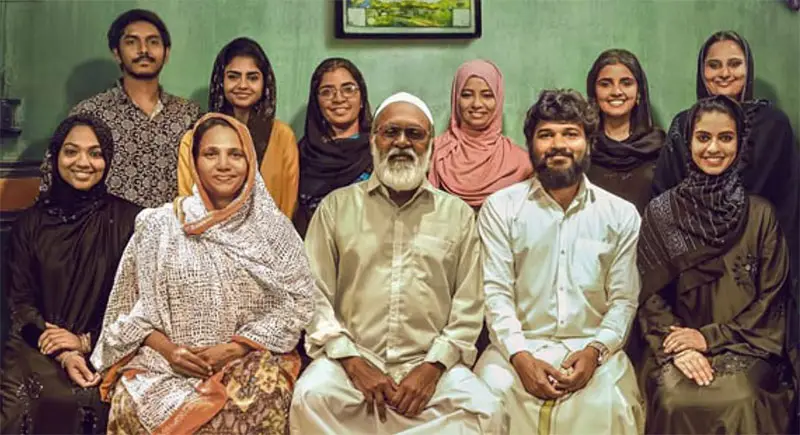
Habibi tells the story of a South Tamil Nadu family that depends on the traditional handloom weaving industry. Kasturi Raja, the second-generation head of the family, struggles financially as the weaving business declines. While his younger brother leaves for an Arab country in search of work, Kasturi Raja remains determined to survive only on the income earned through weaving.
Meanwhile, his son Eesha, who fails his Class 12 examinations, is pressured by relatives to seek employment abroad. However, Eesha refuses to leave his hometown, partly because he does not want to be separated from his school-time love, Malavika Manoj, and partly because he cannot bear the thought of leaving his family behind.
As modern machinery continues to hurt the handloom industry, the family’s financial struggles worsen. Relatives insist that sending Eesha abroad is the only solution. But having witnessed the pain endured by his uncle, who lives away from home for work, Eesha is determined not to suffer the same fate.
The turning point arrives when Eesha visits Malavika’s house at night to confess his love and gets caught by local residents. What follows brings major changes not only to Eesha’s life but also to his entire family. The emotional consequences of these events form the heart of Habibi.
Performances
Kasturi Raja, playing Mohammed Yusuf, delivers an impressive performance. Whether portraying a caring family head, expressing his disappointment over the decline of the weaving industry he loves, or breaking down over his son’s struggles, he handles every emotion with remarkable restraint and authenticity.
Debut actor Eesha makes a strong impression with his youthful charm and natural screen presence. He convincingly portrays the innocence of first love and the awkwardness of expressing his feelings. As the story progresses into more emotionally demanding territory, he demonstrates surprising maturity and earns appreciation for his performance.
Although Malavika Manoj has no dialogue for most of the film and appears veiled throughout, the few lines she delivers in the climax effectively communicate the pain experienced by countless migrant workers and their families.
Thanasree, portraying a Muslim woman who fights for her rights and self-respect despite social restrictions, proves to be a fitting choice for the role.
Supporting actors including Anusreya Rajan, Jaisree Binuraj, Arul Kumar, Rekha Kumanan, Ismath Banu, Malar Kaison, Sun Shakul, Master Dheegan, and Dheeksha Sri contribute effectively to the narrative.
Technical Aspects
Cinematographer Mahesh Muthusamy beautifully captures the story’s journey across different decades, from the 1980s through the 1990s and 2000s to the present day. His visuals also evoke nostalgia for a lifestyle closely connected to nature.
Sam C.S. delivers a soothing musical score. The songs, particularly those rooted in Islamic traditions, blend naturally with the narrative and reflect the emotions of the characters. The background score remains understated and complements the film’s gentle tone.
Art director Appuni Sajan deserves praise for authentically recreating the homes, places of worship, costumes, and atmosphere of different eras.
Editor Mathi V.S. could have trimmed some of the lengthy scenes. While the detailed depiction of Islamic culture and traditions adds authenticity, its repeated emphasis occasionally slows the screenplay.
Direction and Writing
Writer V.S. Mohammed Ameen realistically portrays the culture, economic struggles, and social realities of the Muslim community—subjects rarely explored in mainstream Tamil cinema. The film powerfully highlights that while overseas employment may bring financial gains, the emotional cost of separation is often irreversible.
Director Meera Kathiravan presents the life of a family spanning three generations with remarkable simplicity and realism. Through themes of friendship, love, faith, aspirations, and sacrifice, he successfully conveys that the pain of working far from home is universal and affects not just migrant workers but also the families they leave behind.
Though the storytelling follows a conventional narrative style, Meera Kathiravan succeeds in delivering his message with sincerity and emotional impact. For non-Muslim audiences, Habibi offers a glimpse into a less-explored way of life, while Muslim viewers are likely to appreciate seeing their culture and experiences represented authentically on screen.