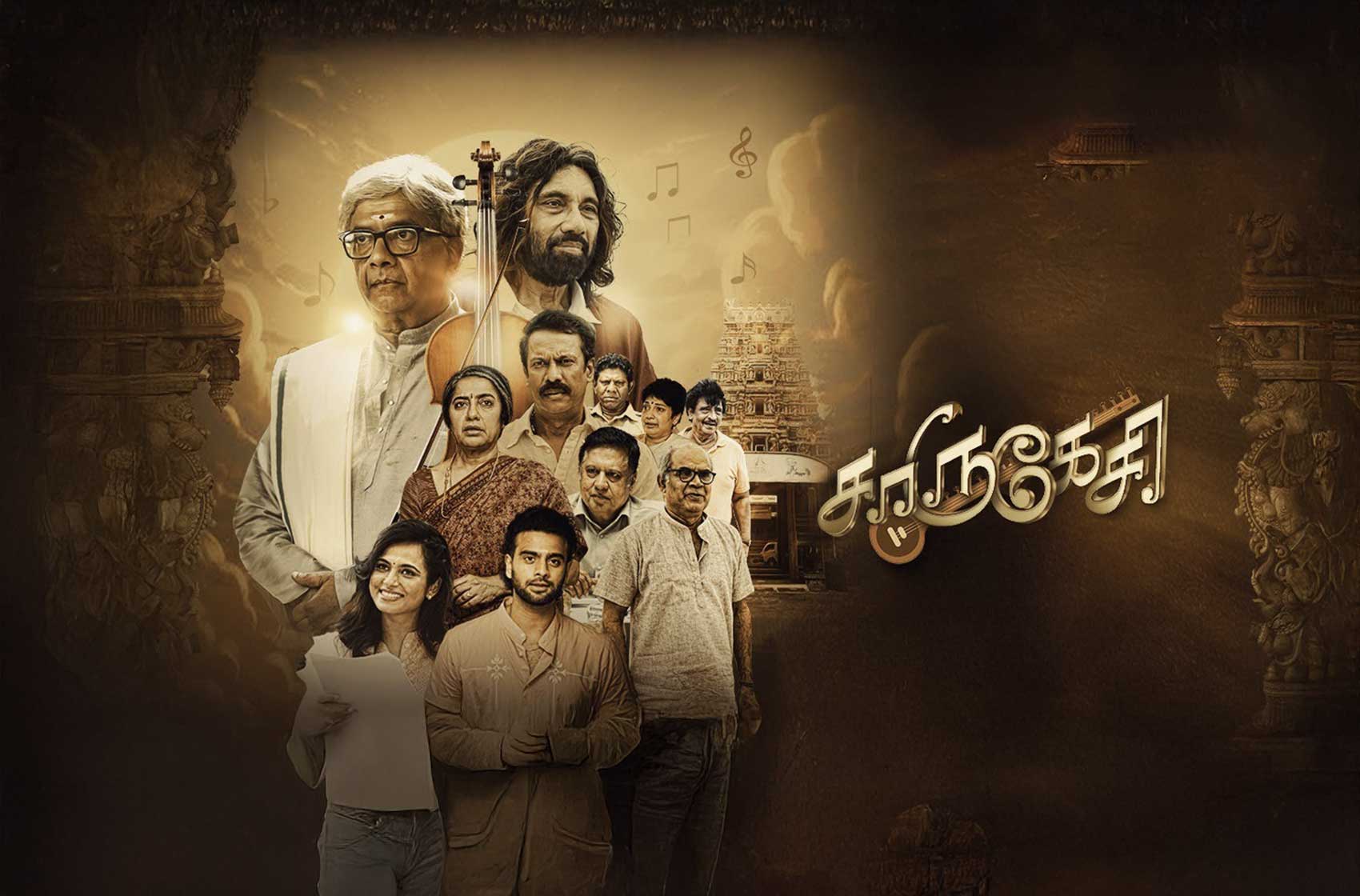
Y.G. Mahendran, a renowned Carnatic singer, lives considering music and his wife Suhasini as his two eyes. Although he has reached the pinnacle of fame, recognition, and wealth in the music world, his personal life is filled with pain. The reason is his only son, Raj Iyyappan. Wanting to live with an identity of his own rather than his father’s, Raj dislikes his father and secretly marries his lover Ramya Pandian without his parents’ knowledge.
Even though the marriage took place without their knowledge, Y.G. Mahendran and Suhasini accept Ramya Pandian as their daughter-in-law. However, to their shock, Ramya reveals a secret known only to them, uses it to threaten them, and discloses her intention of taking revenge on them.
Already suffering because of his son’s actions, what happens to Y.G. Mahendran when faced with his daughter-in-law’s revenge? What is the secret? The film tells this story as the painful life journey of a famous man and as a philosophy that everything eventually passes.
Y.G. Mahendran, who plays the lead role, does justice to the character of Charukesi. He effectively portrays both a celebrated musical legend who has reached the peak of success and an ordinary father who is humiliated by his son. Though his performance appears slightly exaggerated in some places, he balances it well with his body language.
Suhasini, who plays Charukesi’s wife Padma, has done her job well. Although her performance sometimes feels artificial, her screen presence and mature acting add strength to the film.
Raj Iyyappan as Charukesi’s son and Ramya Pandian as his daughter-in-law both shine with energetic performances suited to their age. Their actions against Charukesi make the audience feel angry with them.
Sathyaraj, Samuthirakani, Thalaivasal Vijay, Dheena, Rithvik, Preethika, and the rest of the cast support the screenplay effectively.
Cinematographer Sanjay P.L. seems to have placed the camera in one spot and moved it only the next day. Almost all the scenes are shot from a limited perspective. Since the film relies heavily on dialogues, it is evident that the cinematographer had relatively less visual work to do.
Deva, known for gaana songs, impresses with Carnatic music. His melodious songs are enjoyable enough to be heard repeatedly, and he also evokes nostalgia by incorporating shades of his older compositions. The background score is adequate.
Editor Richard has assembled the scenes in a way that makes the audience feel as though they are reading the life story of Charukesi.
Pa. Vijay’s lyrics and dialogues serve as the film’s pillars. However, many of the dialogues, philosophies, and motivational anecdotes feel outdated, which slightly weakens the film.
Writer Venkat has honestly handled the straightforward life of Charukesi through his story.
Director Suresh Krishna, who wrote the screenplay and directed the film, has created Charukesi as a work that gives people confidence and courage.
Even though cinema offers many possibilities beyond what can be achieved on a stage, Suresh Krishna avoids such distractions and focuses on Charukesi, his pain, his trials, and his achievements. By ensuring these remain etched in the audience’s minds, the director succeeds in his effort.