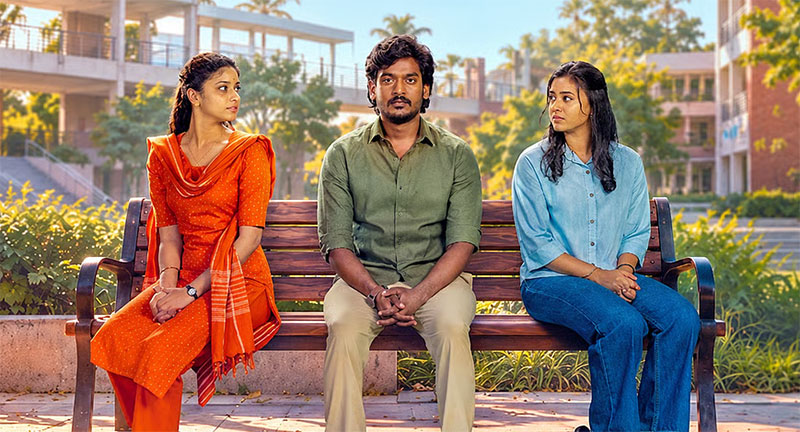
Does Aegan overcome these problems and succeed in love, or does he suffer another heartbreak, just as he did with his first love? What lies behind the problems in his relationships? Haiku attempts to answer these questions through a message that is relevant not only to lovers but also to married couples and people in relationships of all kinds.
Director Yuvraj Chinnasamy appears to have written this story under the influence of Vijay Sethupathi and Trisha’s film 96. This influence is evident on screen, and the director even makes references to certain scenes from that film. Although inspired by another movie, Yuvraj Chinnasamy has built his screenplay around an aspect that was not explored in 96. He attempts to present it in a way that allows lovers to understand the message and relate their own experiences to the story.
Aegan, who has appeared in small roles in a few films, makes his debut as a lead actor with this movie. He delivers a performance that does justice to a character requiring emotional depth and the ability to express a wide range of feelings. However, he falters in a few places. In particular, his body language and emotional expressions in scenes depicting heartbreak and memories of his first love fail to leave a strong impression on the audience.
The two female leads, Sridevi Apalla and Femina George, look like ordinary girls next door. However, they do not quite come across as leading heroines or manage to captivate the audience. As far as their performances are concerned, both actresses do their jobs adequately.
Adhirchi Arun, Subramaniya Sethu, Adhiyamaan and Mime Gopi contribute to the progression of the screenplay. However, their characters have not been written in a particularly memorable way.
Cinematographer Priyesh Gurusamy seems to have assumed that close-up shots of the lovers would be enough to convey their emotions to the audience. He does not appear to have given much thought to presenting them in a visually appealing manner. In particular, the film’s visuals make it difficult to appreciate the ₹11 crore reportedly spent by the producer. The characters and scenes lack the visual vibrancy needed to make the film engaging.
Music and Editing
Music composer Sidhu Kumar is one of the film’s biggest strengths. Both the songs and the background score help compensate for the film’s shortcomings and make it more enjoyable. All the songs are memorable enough to be played repeatedly. The background score effectively conveys the romantic emotions and pain in the scenes, leaving a lasting impression on the audience.
Although the screenplay focuses primarily on relationship problems, separation, falling in love again, fresh conflicts and further breakups, editor Sakthi Pranesh B. works hard to prevent the narrative from losing momentum and helps keep the film moving.
Hariharan Ram, who contributed additional screenplay material, adds an interesting touch to the narrative by presenting an imaginative scenario in which a single boy studies at a women’s college. Although this idea is not essential to the story, it adds a little extra entertainment without feeling too awkward.