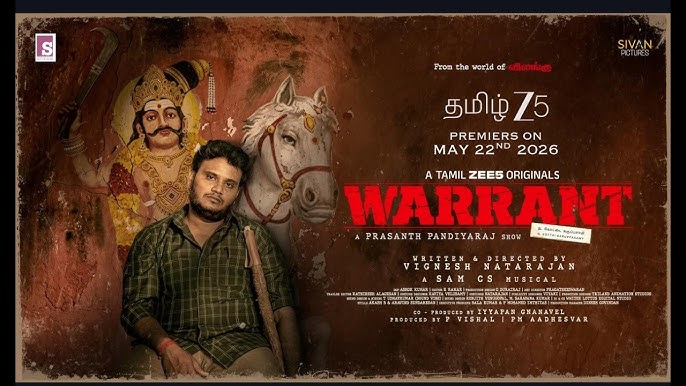
Director Prasanth Pandiyaraj, who drew attention with Vilangu by portraying an unexplored side of the police force with realism and authenticity, has once again surprised audiences. This time, as both the writer and lead actor, he presents another facet of police life in a manner that feels remarkably close to reality.
The protagonist, played by Prasanth Pandiyaraj, is the only child in his family. Determined to secure a government job for his son, his father makes him appear for several government examinations. After failing to clear any of them, he eventually gets him recruited into the police force through a relative who serves in the department.
Joining the police force merely for the security of a government job, he struggles to adapt to its rigid structure. The department’s hierarchy, ego clashes, and negative work culture leave him humiliated and subjected to ridicule by his colleagues.
At one point, he decides to quit the force altogether. However, determined to prove himself to those who looked down upon him, he embarks on a series of bold actions. These decisions ultimately land him in serious trouble. What that trouble is, and whether he manages to overcome it, forms the core of Warrant, which is narrated in a way that evokes sympathy for police personnel.
While the series exposes the brutality behind custodial deaths caused by inhumane police violence, it also explores how ordinary, compassionate individuals gradually change under the weight of the police system, excessive workload, professional disappointments, and constant humiliation. At the same time, it strongly highlights how innocent people suffer due to the arrogance and abuse of power by certain officials.
Prasanth Pandiyaraj is perfectly cast as Kottai Karuppasamy, an innocent and soft-spoken young man affectionately nicknamed “Amul Baby.” His transformation from a simple, harmless individual into someone determined to change his circumstances is portrayed convincingly. Every action he takes to prove his worth is supported by an impressive performance that does full justice to the character.
The female leads, Narmitha M.V., Aruljothi, and Saaya Devi, may not have extensive roles, but they effectively support the narrative. Among them, Saaya Devi’s character and the situations she encounters are particularly engaging.
Balaji Sakthivel as the protagonist’s father, Kousalya as his mother, Aruldoss as the police inspector, Hello Kandasamy as a constable, and the actors portraying Kodai Saravanan, sub-inspectors, and other police personnel are all well-suited to their respective roles.
Ashok Kumar’s cinematography captures police stations and police life with striking realism, making viewers feel as though they are experiencing the environment firsthand.
Sam C.S.’s background score, though occasionally loud, effectively matches the pace of the narrative and adds significant strength to every episode.
Although the story could have been told as a feature film, editor R. Ramar keeps the multi-episode narrative engaging throughout. Even when family and romantic sequences slow the pace, they serve to highlight the mental stress faced by police personnel and the impact of their profession on their personal lives, helping audiences connect more deeply with the series.
The story and screenplay by Prasanth Pandiyaraj and Vignesh Natarajan provide a powerful portrayal of the realities of police work that are rarely depicted on screen. They realistically show how even the most kind-hearted individuals can be transformed by the demands of police service, creating empathy for the force. At the same time, they raise an important question: why does the police department often exercise its authority over ordinary citizens while hesitating to do the same with the wealthy and influential?
Director Vignesh Natarajan deserves credit for holding the audience’s attention for nearly four and a half hours using a story centered on a custodial death. He keeps every episode engaging and emotionally resonant. However, the excessive use of profanity may make some viewers uncomfortable. The absence of censorship on OTT platforms makes such content commonplace, leaving viewers with little choice but to accept it.
At a time when police-based films and series largely follow familiar formulas, Prasanth Pandiyaraj, who previously broke new ground with Vilangu, once again proves through his writing that there are still many untold stories within the police force waiting to be explored.