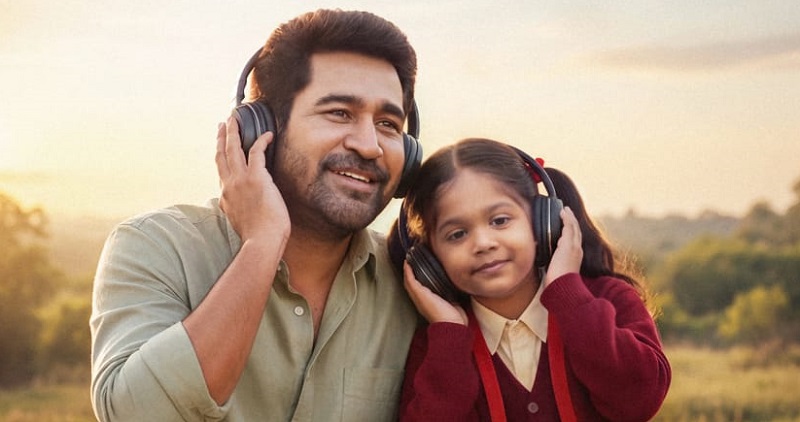
Vijay Antony, who has lost his wife, lives in Ooty with his daughter. Preethi Asrani, the teacher at his daughter’s school, falls in love with Vijay Antony and also shows great affection and concern for his daughter.
Meanwhile, Preethi Asrani spots the woman whom Vijay Antony claims to be his deceased wife, living in Ooty with a husband and child. She informs Vijay Antony about this and feels guilty for having lied to the little girl.
Under these circumstances, Vijay Antony’s daughter suddenly falls ill. After examining her, doctors reveal that the little girl is suffering from a genetic blood disorder and that her condition is critical. They explain that she can be saved only through an immediate bone marrow transplant (stem cell transplant).
This leads to a situation where Vijay Antony and his supposed wife must have another child together. However, it is then revealed that Vijay Antony was never married in the first place. The truth that the little girl is actually an orphan also comes to light.
With the little girl’s survival depending on finding her biological parents, Vijay Antony sets out in search of them. Does he manage to save his adopted daughter with their help? How did a baby end up in the care of Vijay Antony, who was never married? Who is the woman he claimed to be his deceased wife? The answers to these questions form the story of ‘Appa Kutty’.
Based on a real-life incident that took place in North India several years ago, director M. Maran has added several fictional subplots and presented what feels more like a television serial on the big screen.
There was a time when stem cells for bone marrow transplants were obtained from family members. However, in the present day, stem cells can also be obtained from suitable unrelated donors. Some private organisations even operate stem cell banks for this purpose. Without addressing any of these developments, director M. Maran has built his screenplay entirely around an incident from several years ago. By following an outdated approach, he ends up testing the audience’s patience.
Vijay Antony, who plays the lead role, once again portrays a helpless and unfortunate man, as he usually does. The scenes designed to showcase his affection for his daughter feel artificial, and his performance in those scenes feels even more artificial.
Preethi Asrani, who plays a schoolteacher, is given no convincing reason to fall in love with Vijay Antony. As a result, neither her romantic feelings nor her concern for the little girl creates any meaningful impact in the screenplay. Consequently, her performance also fails to make an impression.
Little Lidhanya, who plays Vijay Antony’s daughter, attracts attention with her natural performance and playful dialogue delivery. In particular, a scene lasting approximately two minutes in the climax alone manages to hold the entire film together.
Bhagavathi Perumal, Muthukumar, Aruvi Madhan, Haripriya Isai, Sreeja Ravi, Kumar Natarajan, Praveena, Lizzie Antony, Chitra Lakshmanan, Munnar Ramesh, Jensen Dhivakar, Haritha Mutharasan, Muruganandham R. and the rest of the cast have all performed their respective roles adequately.
Rather than simply making the visuals look beautiful, cinematographer Rajeev Rajendran gives greater importance to conveying the emotions of the characters to the audience.
The songs composed by Vijay Antony complement the storyline and are enjoyable enough to listen to repeatedly. The background score also maintains a measured pace and brings life to the scenes.
Vijay Antony, who has also handled the editing, has put together the scenes neatly and narrated the director’s story in an organised manner.
M. Maran, who has written and directed the film, attempts to deliver an emotional story about the bond between a father and daughter, using a real-life incident from the medical field as its foundation. However, both his effort and the scenes he has written feel disconnected from present-day realities, which becomes the film’s biggest weakness.
Jensen Dhivakar plays a pickpocket. At a time when even the introduction of a pickpocket in Ooty feels outdated, the director still holds on to such old-fashioned sequences. Through several similar outdated scenes, M. Maran seriously tests the audience’s patience.
On one side, director M. Maran’s outdated writing wears down the audience, while on the other, Vijay Antony’s performance as the father becomes difficult to endure. With both of them testing the audience throughout the film through their respective shortcomings, the only slight relief for viewers, who are left exhausted by the overall experience, comes from one scene featuring little Lidhanya in the climax.