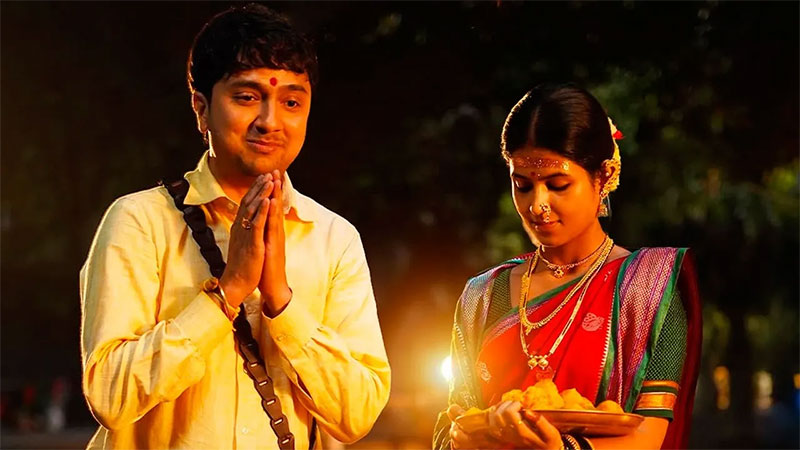
The 2025 Marathi film *Gondhal* has now been dubbed into Tamil and released under the same title. Gondhal is a traditional wedding ritual performed in villages across Maharashtra.
The story is set in a village in Maharashtra during the 1970s. The protagonist, Ishita Deshmukh, is married against her wishes. Following the wedding, the Gondhal ritual is held at the groom’s house, with relatives, the village chief and other villagers taking part in the celebrations.
During this overnight ritual, which begins in the evening and continues until dawn, the village chief’s son, who desires Ishita Deshmukh, attempts to win her over with her consent. Meanwhile, Ishita plans to elope with her former lover. Her husband, Kishor Kadam, an innocent and compassionate man, eagerly awaits the beginning of married life with his beautiful wife. On the other hand, an elderly street-theatre performer, whose son was lost because of the village chief, waits for an opportunity to unleash the desire for revenge he has been carrying within him.
Although the event is a ritual dedicated to God, the night also becomes a battleground for human emotions and psychological conflicts involving love, jealousy, betrayal and power struggles. As the night progresses, a series of mysterious incidents unfolds. What are these incidents? Who is affected by them? And what becomes of the sinister plans hatched under the cover of darkness? Set against the backdrop of an authentic rural ritual, *Gondhal* narrates these events in a realistic and engaging manner.
Yogesh Sohoni, who plays the protagonist, carries an innocent expression and a compassionate nature throughout the film. However, he surprises the audience with a completely different side of his character in the final sequences. He is someone who fails to understand the double-meaning remarks made by those who desire his wife and continues to treat them with affection. The unexpected transformation of his character and the way he conveys his anger through his eyes in the climax are particularly impressive. In the final moments, he manages to outshine even the other actors who have delivered strong performances throughout the film, earning well-deserved applause.
Ishita Deshmukh, who plays the female lead, convincingly portrays herself as the beauty admired by the entire village through her body language and dialogue delivery. Her casual responses to men who yearn for her, the scenes in which she teases them, and her plans to deceive her husband in order to reunite with her lover all reveal the arrogance and romantic feelings within her through a convincing performance.
Kishor Kadam, who plays Bivaba, the senior member of the street-theatre troupe, delivers a compelling performance. Although he conceals the desire for revenge and his determination to destroy the arrogance of those in power, his performance constantly hints that something significant is about to happen through his character.
Nishad Bohir, who plays the village chief’s son; Anju Prabhu, who portrays the heroine’s lover and a street-theatre performer; and Suresh Vishwakarma, who plays the village chief, along with the rest of the cast, convincingly blend into their respective roles as villagers.
Cinematographer Amalendu Chaudhary creates visual magic through his camera work. The story unfolds during a ritual that takes place at night in a location with limited lighting, relying mainly on torches and lamps used for worship. Despite these visual challenges, he captures the proceedings with remarkable realism and brings the atmosphere of the ritual alive on screen.
Ilaiyaraaja’s music draws the audience into the world of the film through traditional Maharashtrian village ritual songs and the instrumental sounds of street theatre. One of the songs is presented as an emotionally moving melody that leaves a lasting impression on the audience.
Despite its slow-paced sequences, lengthy single-shot scenes and numerous dialogue-heavy portions, editor Ashish Mhatre has ensured that the film remains engaging and holds the audience’s attention.
Writer-director Santosh Devkar uses a traditional Maharashtrian cultural ritual as the backdrop for an intriguing crime thriller, exploring the psychological behaviour of people. He has handled the subject with realism and crafted an engaging narrative.
Although the film is dubbed into Tamil and features actors who may be unfamiliar to Tamil audiences, its presentation gives the impression of watching a Tamil film. One of its biggest strengths is the way the narrative unfolds, keeping the audience’s attention firmly on the screen from beginning to end.
By exploring human nature against the backdrop of people’s everyday lives, customs and culture, director Santosh Devkar has delivered a realistic story that transcends language barriers and appeals to cinema lovers.